
The five levels
The degree of doneness tells how far the meat is cooked inside. Outside, every steak carries a crust. Inside, the range runs from tender raw to cooked through. With every level, colour, juice and bite change.
- Rare: red inside, lukewarm, especially soft. Under the crust there is only a wafer-thin grey layer.
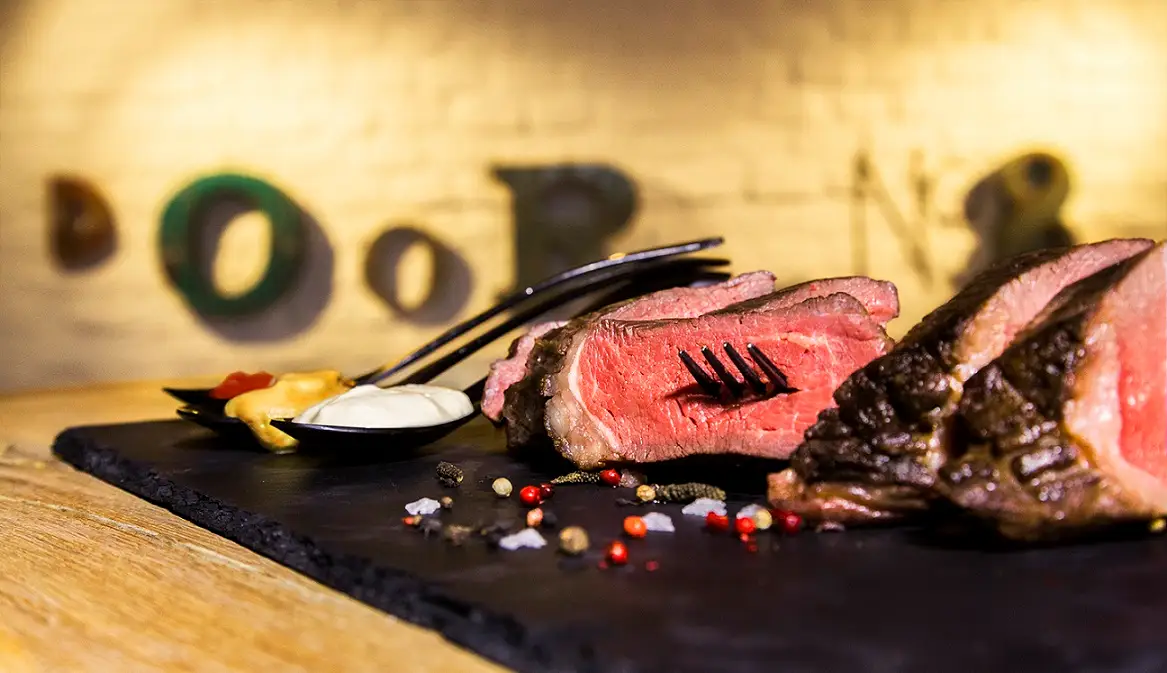
- Medium rare: red to strong pink inside, juicy. The level most kitchens recommend.
- Medium: pink inside, with a firmer bite. The juice is pink, no longer red.
- Medium well: only a pink shimmer left in the middle. The meat is firmer and drier.
- Well done: cooked through, grey-brown, no pink. The firmest, with the least juice.
Why we serve flank and Special Cut medium
Two steaks we deliberately serve at medium: our Flank Steak from the USA and the DOOR No. 8 Special Cut. Both come to the table already sliced – and there is a good reason for it.
The Flank Steak comes from the belly flap and is distinguished by its long, pronounced muscle fibre. In our experience this often remains quite firm at rare. Only at medium does the meat develop, for us, the pleasantly tender texture that makes this cut what it is.
With the Special Cut, on the other hand, the characteristic fat rim is the focus. It needs enough heat to become soft and unfold its buttery consistency. Medium is the ideal point for us: the fat becomes beautifully tender while the meat stays juicy.
That is why we are convinced that medium is the best choice for these two cuts.
Why your doneness is spot on with us
Many of our steaks we first prepare sous vide: vacuum-packed and gently in a water bath at 54 to 60 °C. The water bath has exactly the temperature the meat should reach inside. That way the desired doneness can be controlled precisely instead of just estimated by feel. In our view the best basis for an even result.
Then the steak goes onto our 1,000 °C grill. At this extreme heat an aromatic crust forms within a few seconds, while the inside largely keeps the doneness reached beforehand.
The result: a medium steak with us is evenly pink – from the edge to the core, without the wide grey transition under the crust. That is exactly how we imagine a perfectly prepared steak.
Which doneness for which cut?
Every cut has its own properties and, depending on the doneness, unfolds different aromas and textures. Which doneness tastes best is ultimately also a matter of personal preference. The following recommendations therefore serve as a guide – because tastes, as we know, differ.
A filet can be enjoyed superbly rare. It is especially lean, contains hardly any intramuscular fat and at this doneness convinces with its especially tender texture. If you prefer it cooked a little more, you can of course choose another doneness.
A rib eye shows its strengths between medium rare and medium. The characteristic fat eye needs enough heat to become soft and release its buttery aromas. If it stays too cool, the fat can keep a rather waxy consistency. Here too, personal taste decides in the end.
With steaks on the bone, such as T-bone or Tomahawk, the uneven heat distribution plays a role. The meat directly at the bone cooks more slowly and can therefore stay a little rarer than the outer areas. That means different degrees of doneness can arise within one cut.
Wagyu is a special case. Because of its exceptionally strong marbling it reacts differently to heat than classic steaks. A short, gentle preparation at medium rare at most is recommended. Raw too, for example as sashimi, the special quality of this meat can be enjoyed.
Our tip: Try different degrees of doneness and find out what tastes best to you. Because in the end there is not one right doneness – but the one that suits your personal taste.
And if you are unsure: our service knows every cut and every degree of doneness and is happy to advise you.